


The scaling problem at a glance
Use these four signals to find the section that matters most to your operation.
Most service businesses fail to scale because they confuse business activity with operational capacity. When business expansion relies primarily on the founder’s daily intervention, informal communication, and unstandardized delivery, signing additional accounts does not reliably increase profit margins. Instead, it frequently introduces operational friction, fulfillment delays, and administrative burnout. Sustainable scaling requires separating top-line revenue growth from founder working hours through productized service packaging, integrated software workflows, and structured delivery boundaries.
1. The Capacity Ceiling: Why Busy Teams Stop Expanding
A service company encounters a capacity ceiling when operational complexity increases faster than delivery throughput. Teams remain fully occupied and work long hours, but revenue plateaus because billable capacity is consumed by internal friction, informal handoffs, and operational troubleshooting rather than standardized client execution. Adding new accounts to an unstandardized delivery structure strains team bandwidth without expanding net profitability.
When an organization operates at high exertion across multiple quarters while revenue remains stagnant, the underlying constraint may be delivery capacity rather than marketing volume. In many service businesses, digital agencies, and specialized consulting firms operating between moderate five-figure and low six-figure monthly revenues, increasing client volume can paradoxically diminish operational efficiency.
Each new account introduces administrative handoffs, customized client requests, and unstandardized deliverables. Without documented workflows, the organizational effort required to coordinate projects expands non-linearly.
Hypothetical Scenario: The Coordination Complexity Curve
To illustrate why service teams feel overwhelmed as they grow, consider a simplified organizational model examining internal communication complexity among team members:
In group dynamics and organizational design, the number of potential two-way communication channels between interacting team members is calculated using the combinatorial formula:
C = N × (N − 1) / 2
Where N represents the number of interacting team members working on client delivery.
-
Scenario A (Small Core Team of 4 Members):
When an agency consists of a founder, a designer, a developer, and an account coordinator (N = 4), the internal communication network consists of:4 × (4 − 1) / 2 = 6 potential pathways
At this scale, coordination overhead is minimal. Team members communicate informally, issues are resolved immediately across a shared room or single chat channel, and the founder easily retains operational context across all active accounts. -
Scenario B (Expanded Team of 12 Members):
As client volume grows, the firm hires additional staff across departments, expanding the delivery team to 12 members (N = 12). The internal communication pathways expand to:12 × (12 − 1) / 2 = 66 potential pathways
The number of potential pathways increases by exactly 1,000%, assuming every team member interacts with every other member. Potential pathways do not measure actual message volume. Without rigid operating systems, project managers spend a substantial portion of each workday coordinating handoffs, clarifying ambiguous instructions, and reconciling mismatched file versions.
When a team of 12 lacks standardized operating procedures, team capacity is absorbed by internal alignment rather than client fulfillment. The organization feels perpetually busy, yet deliverable turnaround times lengthen.
5 Observable Symptoms of the Capacity Ceiling:
- Founder-Centric Approvals: Daily work stops moving whenever the founder is in meetings or away from their desk.
- Prolonged Turnaround Times: Standard deliverables take twice as long to complete as they did when the firm was half its current size.
- Margin Compression: Gross revenue increases following a sales push, but operating margins decline due to rework, overtime, or emergency contractor fees.
- Tribal Knowledge Dependence: Delivery quality varies depending on which individual team member handles the account, because processes exist in employee memory rather than centralized documentation.
- Client Onboarding Drag: New clients experience extended administrative delays between contract execution and initial project kickoff.
2. Growth vs. Scaling: The Economic Distinction
Business growth refers to increasing revenue by adding resources at a roughly proportional rate, such as hiring one project manager for every three clients onboarded. Business scaling refers to increasing revenue at a substantially higher rate than costs, achieved by packaging productized offerings, standardizing recurring tasks, and automating administrative handoffs.
The terms “growth” and “scaling” are frequently used interchangeably in business commentary, but in service operations they represent distinct financial mechanics:
- Illustrative Growth Model (Linear Expansion):
Revenue increases 40% ──► Delivery payroll and software overhead increase ~40% ──► Net profit margin remains flat. - Illustrative Scaling Model (Non-Linear Efficiency):
Revenue increases 100% ──► Delivery payroll and software overhead increase ~25% ──► Net profit margin expands significantly.
When an organization pursues linear growth without structural standardization, overhead expands alongside billable revenue. Signing $50,000 in new monthly contracts often forces the immediate hiring of multiple full-time employees, the purchase of additional software licenses, and increased management overhead. If net margins remain flat while operational risk and fixed payroll increase, the business has grown larger without becoming more stable.
The Key Unit Economics of Service Scalability
To evaluate whether a service business is positioned for scale, founders must track three core operational metrics:
- Effective Hourly Rate (EHR):
The actual cash collected divided by the total hours expended across delivery, account management, and revisions:Effective hourly rate = cash collected / total dedicated hoursWhen uncontracted revisions and informal strategy calls occur, the effective hourly rate drops precipitously, eroding project margins. - Capacity Utilization Rate:
The percentage of paid staff hours dedicated to directly billable or core client delivery versus administrative coordination and internal firefighting:Utilization = billable delivery hours / available paid hours × 100Measure utilization from your own time records. A lower rate may reflect coordination work, training, leave, or other nonbillable responsibilities; it does not by itself prove inefficiency. - Scope Realization:
The ratio of contracted deliverables delivered within original specifications compared to total work delivered including unbilled scope additions.
3. The 4 Operational Fractures Common in Service Delivery
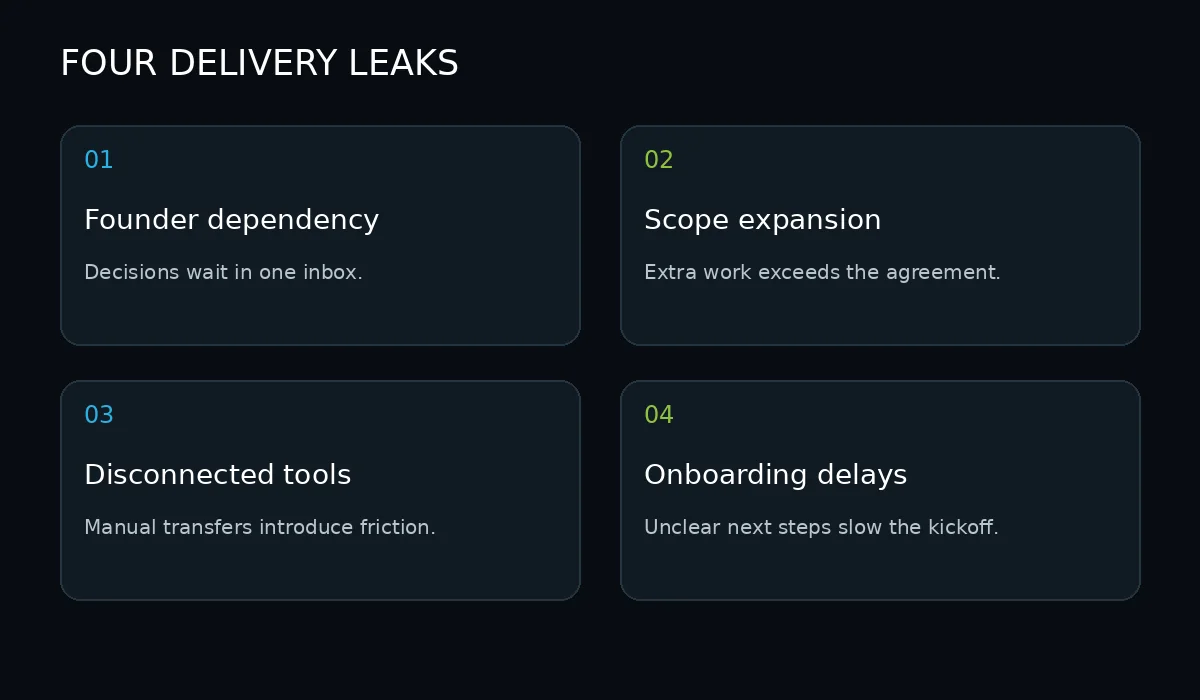
Four common operational fractures that undermine business scalability are founder dependency, uncontracted scope expansion, software tool fragmentation, and unstructured client onboarding. These inefficiencies rarely appear as designated line items on a financial statement; instead, they quietly consume billable capacity, inflate fulfillment costs, and keep founders trapped in daily tactical execution.
Across consulting firms, digital agencies, and specialized service practices, operational inefficiency typically concentrates in four primary operational areas:
Fracture 1: Centralized Founder Dependency (Single Point of Failure)
When operational decisions, technical quality assurance, and client communication depend entirely on founder oversight, the business develops a structural bottleneck. Inquiries regarding deliverable formats, contract terms, or routine revisions route back to the owner’s desk.
This centralized structure produces three clear consequences:
- Operational Stoppages: Client deliverables stall whenever the founder is engaged in business development, traveling, or unavailable.
- Stifled Team Development: Staff members are discouraged from exercising problem-solving initiative because seeking founder approval carries lower personal risk than making an autonomous operational decision.
- Depressed Business Valuation: An advisory firm or agency that cannot function without its founder carries substantial operational risk, capping enterprise value and transferability.
Fracture 2: Uncontracted Scope Expansion (“The Unbilled Favor”)
In service engagements, project requirements frequently expand beyond initial agreements. A scheduled monthly review evolves into multiple weekly strategy discussions, or a predefined design scope expands to include uncontracted revisions.
Because client-facing team members wish to maintain positive client relationships, these requests are frequently accommodated without formal change orders or billing adjustments.
Hypothetical Scenario: The Financial Impact of Unbilled Hours
To demonstrate how minor scope creep impacts annual profitability, consider an illustrative modeling scenario:
- Assumptions:
- A boutique service firm manages 15 ongoing retainer clients.
- Three account managers each accommodate an estimated 4 hours of unbilled client requests per week (extra calls, ad-hoc edits, informal research).
- The firm operates across 50 working weeks per year.
- The internal burdened labor cost of delivery talent is estimated at $40.00 per hour (including salary, benefits, and direct overhead).
- The Calculation:
3 managers × 4 hours/week × 50 weeks = 600 hours600 hours × $40 = $24,000In this hypothetical scenario, the business absorbs $24,000 in direct labor costs annually to fulfill out-of-scope work. This unrecovered labor directly reduces net operating profit unless that work is intentionally budgeted and justified by its commercial value.
Fracture 3: Software Disconnection & Data Fragmentation
Many service organizations adopt disparate SaaS applications over time without establishing a cohesive technical architecture. A typical software stack might include separate tools for internal communication, project boards, spreadsheets, calendar scheduling, contract signing, accounting, and client emails.
When systems do not exchange data via automated integrations, team members must manually transfer information between platforms. Staff members spend recurring hours each week copying client contact details from intake forms into project boards, and from boards into billing tools. This manual data entry increases administrative payroll costs while introducing preventable human transcription errors.
Fracture 4: Friction in Early Client Onboarding
Client retention is heavily influenced by the initial onboarding experience. When a client executes an agreement and encounters administrative delays before project kickoff, buyer confidence can erode rapidly.
An unstructured intake process, characterized by scattered email threads requesting passwords, brand assets, and background materials, delays deliverable milestones and establishes an unorganized operational precedent for the remainder of the client engagement.
4. Comparing Fragile Operations with Scalable Frameworks
The following diagnostic matrix contrasts the operational patterns of a fragile, capacity-constrained business with a standardized, scalable framework:
| Operational Dimension | Fragile Operational Pattern | Scalable Operational Framework |
|---|---|---|
| Client Intake | Ad-hoc emails requesting assets over 7 to 14 days. | Standardized conditional intake form with automated workspace provisioning. |
| Project Tracking | Informal chat threads, unrecorded tasks, missed deadlines. | Centralized kanban boards with stage-based triggers and SLA tracking. |
| Team Training | Verbal explanations and informal shadowing of senior staff. | Documented standard operating procedures (SOPs) with objective review criteria. |
| Inbound Lead Follow-Up | Manual responses sent hours or days after submission. | Automated confirmation and booking workflow dispatched within minutes. |
| Service Packaging | Fully bespoke hourly estimates written for each prospect. | Standardized core service packages with transparent add-on scopes. |
| Scope Management | Verbal accommodations and unrecorded project revisions. | Strict deliverable boundaries with automated change-order requests. |
| Software Architecture | Disconnected SaaS tools requiring manual copy-pasting. | Integrated single source of truth connecting CRM, project tasks, and billing. |
| Founder Role | Daily technical execution, firefighting, and routing tasks. | Systems design, quality auditing, and strategic oversight. |
5. Prioritizing Automation: High-Leverage Workflows vs. Human Judgment
Service businesses should prioritize automating repetitive, rules-based administrative workflows, specifically inbound inquiry routing, calendar booking, intake form dispatch, and milestone billing notifications. In contrast, strategic diagnostic assessments, complex relationship management, and bespoke creative problem-solving must remain human to ensure advisory depth and client trust.
A common pitfall when adopting automation or AI systems is attempting to automate high-context advisory functions while leaving basic administrative tasks manual. Delegating complex strategy to generic prompts risks delivery quality, while manual data entry continues to consume expensive staff hours.
Recommended High-Leverage Automations:
- Prompt Inbound Response Routing:
When a prospective client submits an inquiry, an automated workflow should verify the submission, record the contact in the CRM, and dispatch an immediate acknowledgment containing a calendar link.
Research published in Harvard Business Review (“The Short Life of Online Sales Leads” by James B. Oldroyd, Kristina McElheran, and David Elkington, March 2011) demonstrated that firms attempting to reach potential customers within an hour of receiving an inquiry were nearly seven times more likely to have a meaningful qualification conversation than firms attempting contact an additional hour later. This 2011 observational finding is historical evidence, not a guaranteed outcome for a modern automated acknowledgment. Lead qualification meant a meaningful conversation with a key decision maker. In practice, automated speed-to-lead systems establish contact while buyer intent is highest. - Automated Onboarding Sequences:
When a contract is executed in an e-signature platform, an automated webhook can generate the client’s cloud drive repository, dispatch the onboarding questionnaire, and provide project kickoff guidelines without manual staff intervention. - Internal Milestone Monitoring:
Project management systems can be configured to flag tasks that remain in production past predefined thresholds, enabling management to resolve bottlenecks proactively before delivery deadlines are compromised.
Functions Requiring Direct Human Judgment:
- Initial Operational Diagnostics: Identifying the root cause of an operational plateau requires nuanced interviewing, situational awareness, and industry experience that cannot be replicated by rigid forms.
- Strategic Business Advising: Tailoring operational reorganization, pricing overhauls, or partner strategy requires seasoned human evaluation.
6. A 5-Stage Framework for Operational Scalability
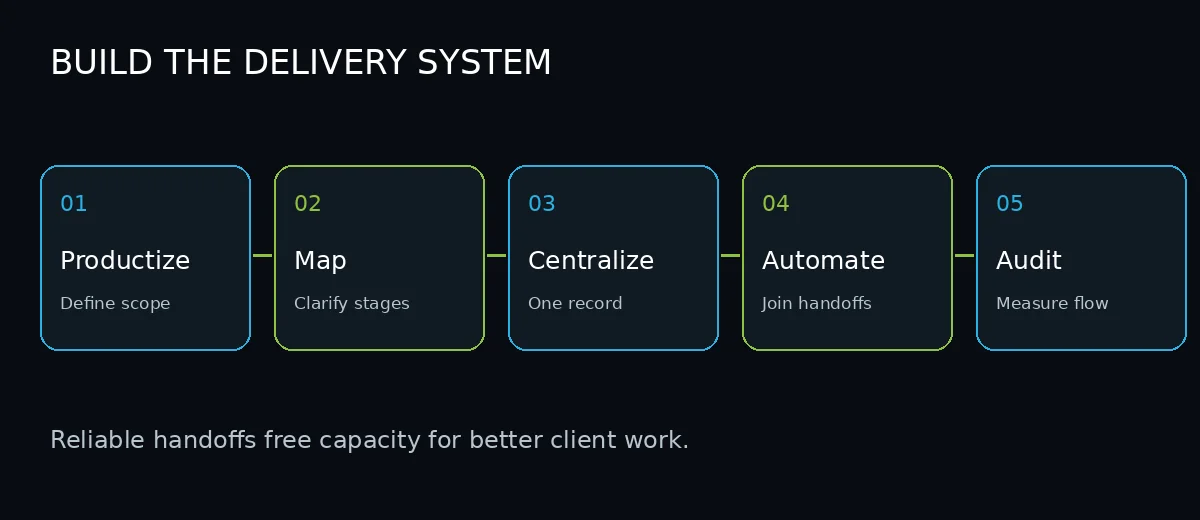
Building operational scalability requires packaging services into productized offerings, mapping linear delivery stages, establishing a single source of project truth, automating handoffs between phases, and shifting the founder’s focus from execution to systems auditing. This architecture decouples delivery throughput from founder availability.
To establish sustainable delivery capacity, organizations can implement a structured 5-stage framework:
Stage 1: Productize ──► Stage 2: Map Workflow ──► Stage 3: Centralize Systems ──► Stage 4: Automate Handoffs ──► Stage 5: Operational AuditingStage 1: Productize the Core Offering
Rather than creating customized service scopes for every client, define a standardized core offering with explicit deliverables, set pricing, and clear fulfillment timelines. Standardized services allow organizations to train team members effectively, control delivery scope, and establish predictable margins.
Stage 2: Map the Linear Delivery Process
Document each operational step a client navigates, structured into distinct linear stages:
- Inquiry & Qualification: Evaluating prospect fit against clear criteria.
- Diagnostic Review: Uncovering root operational requirements.
- Agreement Execution: Standard contract execution and initial payment.
- Structured Intake: Gathering requisite assets through a single form.
- Execution & Quality Gate: Fulfilling deliverables against documented standards.
- Client Sign-Off: Reviewing completed deliverables against agreed milestones.
- Ongoing Review & Retention: Maintaining scheduled touchpoints and proactive reporting.
Stage 3: Establish a Centralized System of Record
Consolidate disjointed tools into a primary operational system (such as an integrated CRM or structured Kanban platform). Requiring all client statuses, communication logs, and deliverables to reside in a single environment eliminates data silos and clarifies accountability.
Stage 4: Automate Handoff Points
Examine the transitions between workflow stages where delays typically occur. Integrating software triggers across these seams, such as automatically issuing an intake form upon contract completion, reduces administrative latency.
Stage 5: Shift to an Auditing Model
As standardized workflows take hold, the founder transitions from fulfilling client work to auditing operational flow. This involves reviewing turnaround times, monitoring margin performance, and addressing delivery bottlenecks.
7. The 72-Hour Operational Readiness Checklist
To evaluate whether your service organization is operationally configured for scale, review the following audit checklist across core operational pillars:
Scope & Financial Protection
- Every recurring client engagement has a written, signed scope of work detailing specific deliverable inclusions and revision limits.
- An established written policy exists for handling out-of-scope requests via formal change orders.
- Effective hourly rates are reviewed quarterly across all active accounts to identify margin erosion.
Lead & Client Intake Workflows
- Inbound contact form submissions trigger an automated confirmation and calendar link within 5 minutes.
- New client onboarding is managed through a single structured form rather than scattered email requests.
- Dedicated project repositories and client communication channels are provisioned automatically upon contract signing.
Delivery & Team Operations
- Core deliverables have documented standard operating procedures (SOPs) with clear pass/fail criteria.
- Project statuses, deadlines, and assigned owners are visible on a centralized dashboard accessible to the entire delivery team.
- Projects have pre-set milestone budgets with alerts configured when tasks exceed 80% of allocated hours.
8. Establishing Service Level Agreements (SLAs) for Operational Flow
To prevent client delivery from devolving into chaotic urgency, scalable service organizations implement internal and external Service Level Agreements (SLAs). An SLA establishes objective, agreed-upon timelines for recurring operational touchpoints, removing emotional negotiations from daily execution.
Illustrative SLA Targets to Adapt to Your Team Capacity:
- Inbound Inquiry Acknowledgment: Automated response within 5 minutes; human qualification review within 2 business hours.
- New Client Onboarding Kickoff: Intake form dispatched immediately upon agreement signing; initial onboarding milestone call scheduled within 3 business days of form completion.
- Routine Client Inquiries: Standard client email or portal messages acknowledged within 4 business hours, with full resolutions or status updates provided within 24 business hours.
- Standard Deliverable Review Windows: Clients receive a defined 5-business-day window to provide consolidated feedback on project milestones. Agree any acceptance-by-silence provision explicitly in the contract before work begins; otherwise follow up and document approval rather than treating silence as consent.
- Emergency Escalation Protocol: Explicitly define what constitutes an operational emergency (e.g., live software outage or revenue-impacting data breach) versus routine operational requests, accompanied by a dedicated escalation channel that bypasses standard email queues.
9. Calculating Your Operational Debt Score
Just as software engineering teams accumulate technical debt when writing quick, unstructured code, service organizations accumulate operational debt when adopting temporary manual workarounds instead of engineering scalable systems.
To assess the operational health of your service delivery, evaluate your organization against the following 10-point diagnostic scale:
| Diagnostic Question | Points (Yes = 1, No = 0) |
|---|---|
| 1. Can your delivery team complete standard deliverables if the founder takes an unannounced 14-day absence? | [ ] |
| 2. Do you have a centralized, written standard operating procedure (SOP) library updated within the last 90 days? | [ ] |
| 3. Does your business respond to new inbound leads with automated scheduling links in under 5 minutes? | [ ] |
| 4. Is all client communication centralized inside an official portal or ticketing system rather than personal founder text messages? | [ ] |
| 5. Are project deliverables packaged into standardized scopes with defined revision limits rather than open-ended custom work? | [ ] |
| 6. Do you automatically issue a formal change order invoice whenever a client requests out-of-scope work? | [ ] |
| 7. Does your project management software automatically notify managers when a task remains idle for over 48 hours? | [ ] |
| 8. Do you review effective hourly realization rates per client on a quarterly basis? | [ ] |
| 9. Does your software stack automatically pass customer contact and payment data without manual copy-pasting? | [ ] |
| 10. Can new delivery team members achieve full fulfillment autonomy within 30 days using documented training SOPs? | [ ] |
Interpreting Your Score:
This is an informal self-assessment, not a validated diagnostic instrument or a prediction of growth. Use the score to prioritize questions, then validate them against delivery records.
- 8 to 10 Points (Scalable Operations): Your organization has established robust systems decoupling revenue from individual bandwidth. Validate readiness through measured workload and delivery performance before increasing volume.
- 5 to 7 Points (Moderate Operational Debt): Your business is functional but fragile. Increasing client volume may expose delivery delays, margin erosion, or excessive founder dependence. Focus immediately on standardized intake and productized scopes.
- 0 to 4 Points (Severe Capacity Trap): Your business operates as a collection of informal habits centered around founder heroics. Do not spend additional capital on aggressive sales or advertising until core fulfillment workflows and single-source-of-truth project boards are installed.
Frequently Asked Questions (People Also Ask)
Why do many service businesses plateau as they grow?
Many service businesses experience growth plateaus because their operations rely on the founder’s personal capacity. Without documented processes and productized services, adding clients increases administrative complexity faster than delivery throughput, leading to operational bottlenecks.
What is premature scaling in a service business?
Premature scaling involves investing heavily in aggressive marketing and sales before establishing a repeatable fulfillment process. Introducing high client volume into an unstandardized delivery system can lead to fulfillment delays, client churn, and operational strain.
How can founders reduce operational bottlenecks without hiring immediately?
Founders can reduce operational bottlenecks by packaging bespoke services into fixed-scope offerings, mapping clear delivery stages, automating administrative intake workflows, and establishing written operating standards for recurring tasks.
What distinguishes an operational systems audit from financial accounting?
Financial accounting categorizes historical income and expenditures on a profit-and-loss sheet. An operational systems audit evaluates the underlying workflows, software integrations, and delivery handoffs to identify where time, capacity, and margin are being lost in daily execution.
Exploring Operational Clarity
Building an enduring service business requires aligning operational delivery with business strategy. At The Retired Consultant, we assist service-business owners in identifying operational friction, streamlining technology platforms, and establishing practical systems designed for sustainable delivery.
👉 Review Advisory Services & Pricing
👉 Schedule an Introductory Diagnostic Call With Faiz Ahmed
