


Find the leak before adding more sales
Use these four checkpoints to navigate the audit and protect margin.
A revenue leak is the loss of earned margin between a signed agreement and cash collection. It usually appears as unbilled work, repeated administration, delayed handoffs, unused software, or late invoicing rather than as a clearly labelled expense. The practical fix is to trace one client journey from inquiry to payment, measure the work actually performed, and install controls at the points where time or cash escapes.
1. What Is a Revenue Leak in a Service Business?
A revenue leak is operational value that a business creates but does not retain. It can be work delivered outside scope, paid capacity consumed by rework, an invoice triggered late, or a sales opportunity left waiting because ownership was unclear. A profit-and-loss statement records the final financial result; it does not automatically explain which workflow caused the margin loss.
In a product business, unsold or damaged inventory is often visible. In a service business, the primary inventory is skilled time, attention, access, and decision-making capacity. Those resources expire as the week passes. If a strategist spends two hours reconstructing information that should have arrived through intake, those hours cannot be sold again. If a project manager repeatedly copies the same client details between tools, the payroll cost is real even when no accounting category says “duplicate administration.”
This is why revenue can rise while available cash, founder time, and delivery confidence remain flat. The company may be selling more work while simultaneously absorbing more non-billable effort. The symptoms tend to appear indirectly:
- projects feel busy but finish late;
- senior people answer routine questions;
- account profitability is estimated rather than measured;
- the same client information exists in several places;
- invoices depend on someone remembering a milestone;
- “small” favours accumulate without a commercial decision.
Revenue leak, cost, or investment?
Not every non-billable hour is a leak. Training, quality control, relationship development, and process improvement can be intentional investments. A cost becomes suspicious when it is unplanned, repeated, preventable, and disconnected from a clear business decision.
Use four questions to separate a leak from an investment:
- Was the work expected when the price and scope were approved?
- Can the business identify an owner and a reason for the work?
- Is the effort measured against an outcome or learning goal?
- Would the same avoidable effort recur for the next client?
If the answer to the first three questions is no and the fourth is yes, the activity deserves investigation.
Hypothetical scenario: the mechanics of an unbilled leak
Consider a fictional monthly engagement priced at $5,000 for an expected 20 hours of combined delivery and account management. Assume the team actually records 34 hours because the intake was incomplete, revisions were informal, and decisions were scattered across email and chat.
The extra 14 hours do not prove that the client is unprofitable. That conclusion would require the business’s actual labour cost, overhead allocation, collection history, and commercial context. The example simply exposes the operational variance:
Actual hours − planned hours = delivery variance
34 hours − 20 hours = 14 unplanned hours
Management can then ask whether those hours created deliberate value, reflected an underpriced scope, or resulted from preventable friction. The useful output is not a dramatic percentage. It is a decision: adjust the package, improve intake, create a change order, or accept the work intentionally.
2. The Five Major Revenue Leaks
Five recurring leak categories deserve attention: unbilled scope expansion, slow lead response, onboarding friction, disconnected software, and billing delay. They affect different parts of the client journey, but all share one pattern: value is created or demand exists, yet the operating system fails to convert it into protected margin and collected cash.
The list below is a diagnostic model, not a claim that every service company has all five problems. Start with evidence from your own contracts, time records, task history, software bills, and invoices.
Leak 1: the polite favour
Scope creep often begins with a reasonable request: one more revision, a quick call, a report in a different format, or advice outside the agreed deliverable. The problem is not generosity. The problem is making repeated commercial decisions without recording them.
A healthy scope-control process gives the delivery team three options:
- complete the request because it is already included;
- approve it as an intentional goodwill exception and record the reason;
- pause and issue a priced change order before work continues.
Without those options, client-facing staff are forced to choose between protecting the relationship and protecting the margin. Good systems remove that false choice.
Illustrative calculation: imagine three account managers each provide four unbilled hours per week for 50 working weeks. That equals 600 hours of additional work. If the company chooses an illustrative internal cost of $40 per hour for scenario planning, the modelled direct labour exposure is $24,000:
3 × 4 × 50 = 600 hours
600 × $40 = $24,000
This is a hypothetical planning model, not a benchmark or a claim about Faiz’s clients. Replace every assumption with your own records before using it for a decision.
Leak 2: slow ownership after an inquiry
Lead response is not merely a marketing concern. It is an operational handoff between a website, inbox, CRM, calendar, and responsible human. When that handoff has no defined owner, interested prospects wait while the business assumes someone else has replied.
Historical research published by Harvard Business Review in March 2011 found that companies attempting to contact a lead within an hour were nearly seven times as likely to qualify it as companies attempting contact even an hour later. The study’s definition involved a meaningful conversation with a decision-maker; it does not mean an automated acknowledgement guarantees a sale. It supports a narrower lesson: response ownership and timing matter. (“The Short Life of Online Sales Leads”)
A practical response flow can acknowledge receipt immediately, create a CRM record, notify the responsible person, and offer the next relevant step. Qualification and advice should still involve human judgement where the situation requires it.
Leak 3: onboarding friction
The period after agreement and payment should convert a sale into an executable project. Instead, many teams begin with scattered requests for passwords, brand files, background details, and stakeholder availability. Work cannot start, the client does not know what happens next, and the team spends time chasing inputs.
The solution is not necessarily more software. It is a defined readiness gate:
- one owner for the onboarding stage;
- one structured intake destination;
- a visible list of required assets;
- a clear definition of “ready for delivery”;
- an escalation path for missing information.
Automation can distribute forms and create folders, but the underlying requirements must be clear first.
Leak 4: software and data fragmentation
A tool can be individually useful and still create system-wide friction. Problems appear when client names, status, files, dates, and billing information must be re-entered across several applications.
Review the flow of information rather than counting subscriptions alone. A low-cost tool that causes weekly manual reconciliation may be more expensive than a higher-priced platform that removes duplicated work. Conversely, consolidation is not automatically efficient if the chosen platform is difficult for the team to use.
Map each critical field:
- Where is it first captured?
- Which system owns the authoritative value?
- Which roles need it?
- Where is it copied manually?
- What happens when two versions disagree?
The goal is a reliable source of truth, not an arbitrary “all-in-one” purchase.
Leak 5: milestone and invoice slippage
Completed work does not become cash until the billing condition is recognised, the invoice is issued, and the client can pay it. If that process depends on memory, a finished milestone can sit unnoticed.
Define billing triggers in operational language. “Invoice phase two when the client approves the final design” is more useful than “invoice later.” Then specify where approval is recorded, who owns the trigger, and what evidence is required.
Automation is appropriate when the rule is clear. For example, moving an approved deliverable into a verified status can alert finance or prepare an invoice for review. High-risk financial actions should retain suitable approval and reconciliation controls.
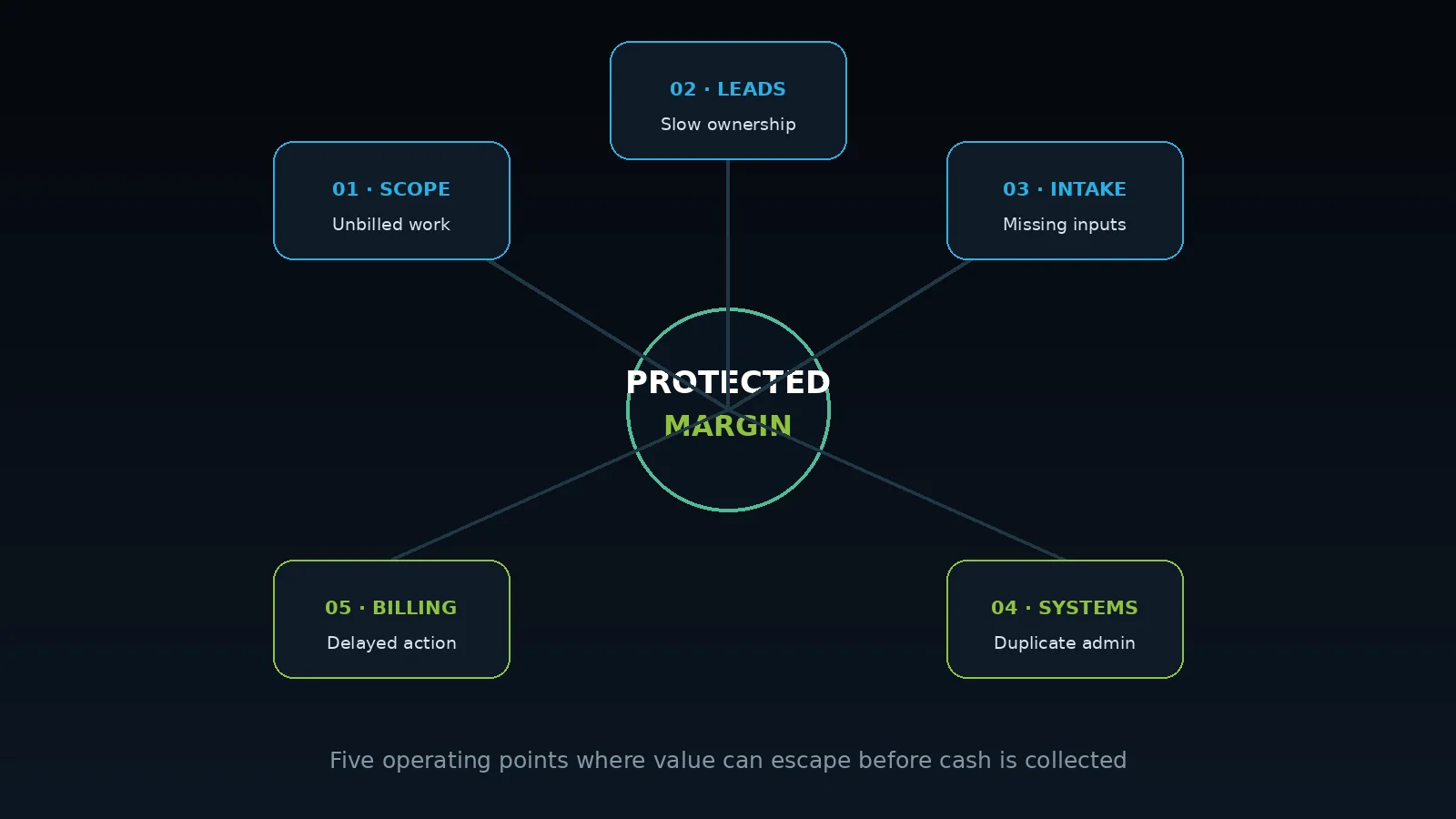
3. Revenue Leak Diagnostic Matrix
A diagnostic matrix converts vague frustration into observable operating evidence. Compare the fragile pattern with the protected pattern, then verify which description matches your contracts, task history, response logs, time records, and invoices. Treat the matrix as a set of questions rather than a maturity score.
| Revenue dimension | Leaky operating pattern | Margin-protected pattern |
|---|---|---|
| Scope management | Verbal exceptions, open-ended revisions, work begins before a commercial decision. | Written boundaries, recorded exceptions, and a change-order path before additional work. |
| Lead response | Submissions land in a shared inbox with no named owner or response clock. | Acknowledgement, CRM capture, ownership, and a defined human follow-up step. |
| Client intake | Assets arrive through scattered messages and work starts with missing information. | One conditional intake path and a visible readiness checklist. |
| Delivery time | Hours are estimated after the fact and repeated rework is not categorised. | Planned effort is compared with actual effort and variances receive a reason. |
| Billing execution | Invoicing depends on someone remembering that a milestone finished. | Operational status produces an owned billing action with evidence and review. |
| Software stack | Client data is copied between disconnected tools and conflicting versions persist. | Authoritative fields have a defined system of record and controlled integrations. |
Read the matrix by client, not by company
Company-wide averages can hide the account that needs attention. Choose a representative set of engagements: one apparently healthy account, one difficult account, and one recent onboarding. Compare them using the same fields.
For each engagement, capture:
- contracted deliverables and revision limits;
- planned and actual delivery effort;
- first inquiry and first meaningful response timestamps;
- onboarding completion date and missing-input delays;
- milestone completion and invoice dates;
- software or handoff failures that created duplicate work.
The comparison helps distinguish an isolated exception from a repeatable operating defect.
4. Run a 72-Hour Revenue Leak Audit
A 72-hour audit is a focused evidence-gathering sprint. On day one, reconcile scope and delivery effort. On day two, trace lead and onboarding handoffs. On day three, inspect software ownership and the path from milestone to invoice. The objective is not to redesign the company in three days; it is to identify the first few leaks worth fixing.
Before the audit: choose a bounded sample
Select a manageable set of recent work rather than analysing every record. The sample should be large enough to reveal patterns but small enough to verify carefully. Use existing evidence and document any missing data instead of filling gaps with assumptions.
Create a simple audit log with these columns:
| Evidence | Expected state | Observed state | Variance | Owner | Next decision |
|---|---|---|---|---|---|
| Contract and task record | Work matches written scope | Extra revision completed | Scope expanded | Account owner | Price, waive, or prevent recurrence |
| Inquiry timestamp | Named owner receives alert | Shared inbox only | Ownership unclear | Sales lead | Define routing rule |
| Milestone and invoice | Invoice action follows approval | Issued several days later | Billing delay | Operations/finance | Add owned trigger |
Day 1: scope, effort, and effective hourly rate
Start with the contract, proposal, or statement of work. List the promised deliverables, included revisions, meeting expectations, and approval conditions. Then inspect the corresponding project board, time records, calendar events, and revision history.
Calculate an engagement-level effective hourly rate only when the underlying records are sufficiently complete:
Effective hourly rate = cash collected ÷ verified delivery and account-management hours
Do not compare that number with a generic internet benchmark. Compare it with the company’s own pricing assumptions and minimum acceptable economics. Record material variance and its cause:
- extra work requested and approved;
- preventable rework;
- incomplete intake;
- internal training;
- quality problem;
- inaccurate original estimate.
Different causes require different fixes. A change order will not solve poor quality, and automation will not solve an unrealistic scope.
Day 2: inquiry and onboarding stopwatch
Submit a controlled test through the public contact path. Use test details that cannot be confused with a genuine prospect. Observe:
- whether the submission succeeds;
- whether the user receives a clear confirmation;
- where the record appears;
- who is notified;
- whether the next step is appropriate;
- whether a responsible human can see the context.
Then trace a recent real onboarding using existing records. Measure time between agreement, payment if applicable, intake dispatch, receipt of required assets, and delivery readiness. Separate client-caused waiting from internal waiting so the team does not optimise the wrong problem.
Day 3: system ownership and cash conversion
Review the recurring software statement alongside actual tool usage. Identify duplicate capabilities, inactive seats, manual exports, and fields maintained in multiple systems. Do not cancel tools impulsively; first identify which workflow, archive, integration, or compliance need depends on them.
Finally, follow two completed milestones through invoicing and collection. Ask:
- What event made the milestone billable?
- Where was that event recorded?
- Who was responsible for the billing action?
- How was accuracy reviewed?
- Could the client pay through the expected method?
- Was any delay caused by missing approval or internal administration?
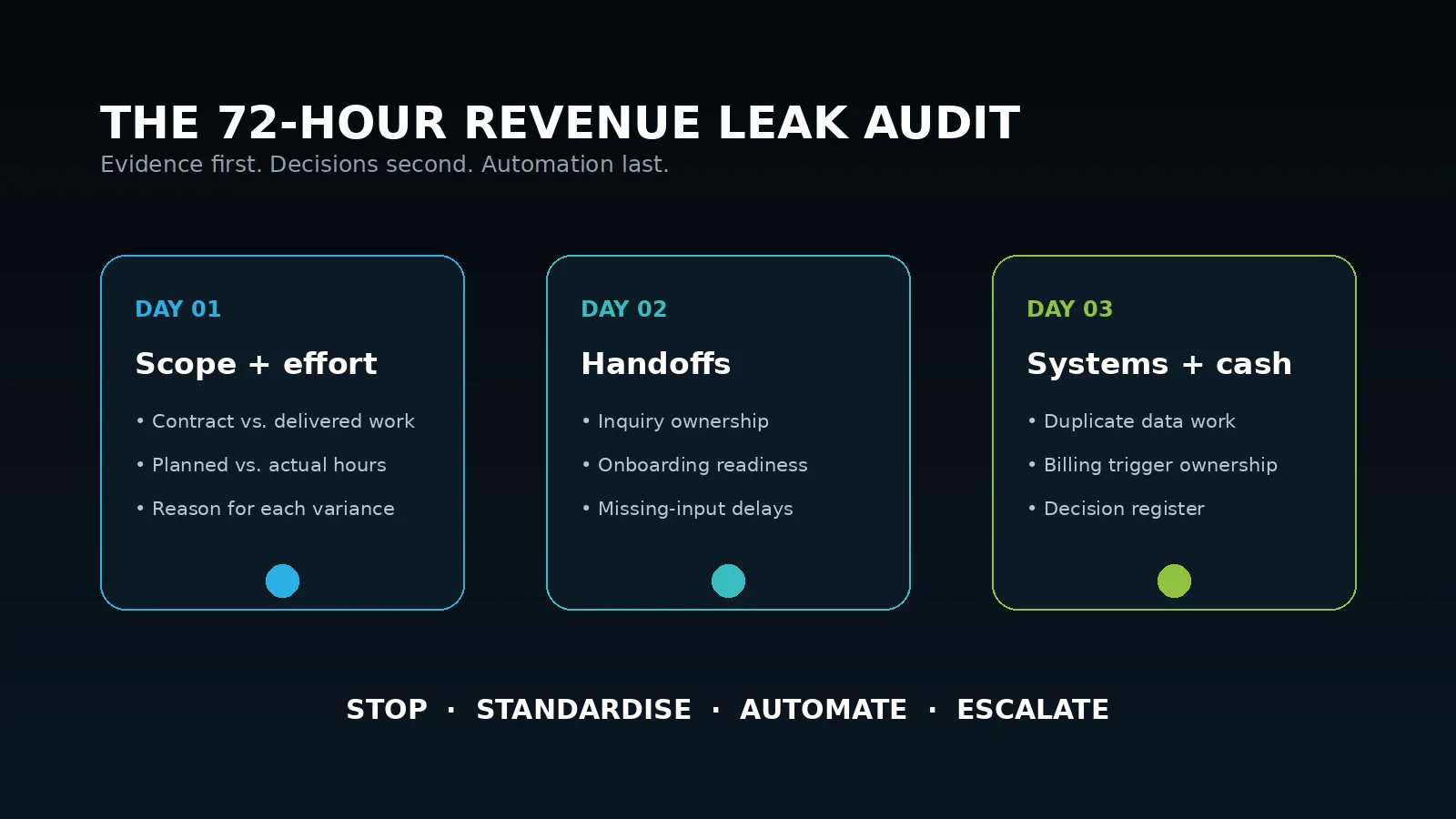
End the audit with a decision register
Do not finish with a long list of observations. Convert each material issue into one of four decisions:
- Stop: remove work or a tool that creates no justified value.
- Standardise: document the expected path and acceptance criteria.
- Automate: connect a stable, repeatable rule after it is understood.
- Escalate: assign a human decision where judgement, approval, or risk requires it.
Rank decisions by recoverable value, frequency, customer impact, and implementation effort. Fixing one recurring leak is more useful than launching ten disconnected initiatives.
5. Install Guardrails Without Damaging Client Experience
Revenue protection should make the client journey clearer, not colder. Effective guardrails explain what is included, show progress, surface decisions early, and give staff a respectful way to handle exceptions. Automation should enforce stable rules while people retain control over judgement, relationships, pricing exceptions, and risk.
Scope guardrail
Translate the agreement into the delivery system. Tasks should show the package, included revisions, approval owner, and change-order route. When a request falls outside scope, staff need a prepared response that acknowledges the request and offers a clear commercial next step.
Intake guardrail
Use conditional intake so clients see only relevant questions. Explain why each sensitive or technical item is needed, provide secure collection methods where appropriate, and show what happens after submission. A form is not a complete process unless someone owns incomplete responses.
Capacity guardrail
Set planned effort at the deliverable level and review variance before the budget is fully consumed. An alert should start a conversation, not automatically blame the team. The cause may be scope expansion, estimation error, client delay, training, or quality correction.
Billing guardrail
Connect billable events to an owned action and retain review appropriate to the transaction. The system should preserve evidence of approval, invoice status, and exceptions. Avoid treating silence as acceptance unless the contract explicitly establishes that rule and it is appropriate for the engagement.
Software guardrail
Assign an owner to every critical client-data field and integration. Document what happens when an automation fails, how duplicates are resolved, and which system wins in a conflict. The fallback procedure matters as much as the happy path.
6. Measure Whether the Fix Worked
A leak is fixed only when operating evidence changes. After implementing a guardrail, compare the same engagement-level measures used during the audit: scope variance, preventable rework, response ownership, onboarding readiness, milestone-to-invoice time, and duplicated administration. Use your own baseline and review period rather than an unsupported universal target.
Choose a small scorecard:
- percentage of sampled projects with written scope exceptions;
- planned versus actual effort by deliverable;
- count of preventable rework events;
- inquiries without a named owner;
- time between intake completion and delivery readiness;
- time between verified billing event and invoice action;
- number of critical fields copied manually between systems.
Metrics should lead to a decision. If a number changes but nobody knows what action follows, it becomes reporting theatre.
Watch for displacement
Improving one metric can move friction elsewhere. Faster acknowledgement may create low-quality meetings if qualification is removed. Strict scope control may damage trust if staff cannot make sensible exceptions. Tool consolidation may create a new bottleneck if access and training are poor.
Review the full client journey after each change:
- Did the customer experience become clearer?
- Did staff perform less avoidable work?
- Did commercial decisions become visible?
- Did cash-conversion steps become more reliable?
- Did the control introduce a new risk?
7. A Practical 30-Day Repair Sequence
The safest repair sequence begins with visibility, then standardisation, then automation. Week one establishes evidence and ownership. Week two fixes scope and intake. Week three connects delivery and billing. Week four reviews results and removes controls that created unintended friction.
Week 1: establish the baseline
Complete the bounded audit, agree on definitions, and assign owners. Do not buy new software yet. Capture the current workflow and decide which records are trustworthy enough to measure.
Week 2: protect the edges of delivery
Clarify package boundaries, revision rules, intake readiness, and exception handling. Give the team scripts and decision paths so they can protect margin without sounding defensive.
Week 3: connect stable handoffs
Automate only the steps that are already understood: record creation, notifications, intake dispatch, status alerts, and billing preparation. Keep human review where context, finance, or client relationships require it.
Week 4: verify and simplify
Compare the new evidence with the baseline. Remove duplicate steps, correct false alerts, and document what happens when the system fails. A smaller reliable workflow is preferable to a complex automation nobody trusts.
Frequently Asked Questions
What is the most common revenue leak in a professional service business?
Unbilled scope expansion is a common and highly visible place to investigate, but no universal ranking applies to every company. Review actual scope exceptions, revision history, meeting time, and change orders. In some businesses the larger issue may be rework, delayed invoicing, incomplete intake, or fragmented systems.
How much revenue does an average service company lose to operational leaks?
There is no defensible universal percentage in the supplied evidence for this article. The accurate answer must come from the company’s own contracts, time records, rework, software costs, billing events, and collections. Use a bounded audit to calculate verified exposure instead of applying an unsupported industry average.
Can revenue leaks be fixed without hiring more employees?
Often, yes. Clarifying scope, removing duplicate administration, improving intake, assigning handoff ownership, and connecting stable billing triggers can recover capacity before hiring. Hiring may still be appropriate when measured demand exceeds a well-run team’s capacity; it should not be used to hide an undefined process.
What is the difference between a revenue leak and a regular business expense?
A regular expense is visible and intentionally approved, such as payroll, rent, or a software subscription. A revenue leak is preventable value loss inside the operating process, for example unrecorded extra work, repeated rework, delayed billing, or paid time spent reconciling conflicting systems.
Should every leak be automated?
No. Automate stable, repeatable rules after the process is understood. Keep human judgement for diagnosis, pricing exceptions, relationship decisions, financial approval, and unusual risk. Automating a confused process usually makes the confusion happen faster.
Turn the Audit Into an Operating Decision
The purpose of a revenue-leak audit is not to produce a dramatic list of problems. It is to identify where the business repeatedly gives away time, delays cash, or creates avoidable work, and then make those commercial decisions visible.
Start with one client journey, use evidence already inside the business, and fix the first recurring handoff. Review our core advisory services or request a free 15-minute introduction. We can decide whether a focused next step exists without pretending that every problem needs a large transformation.
